
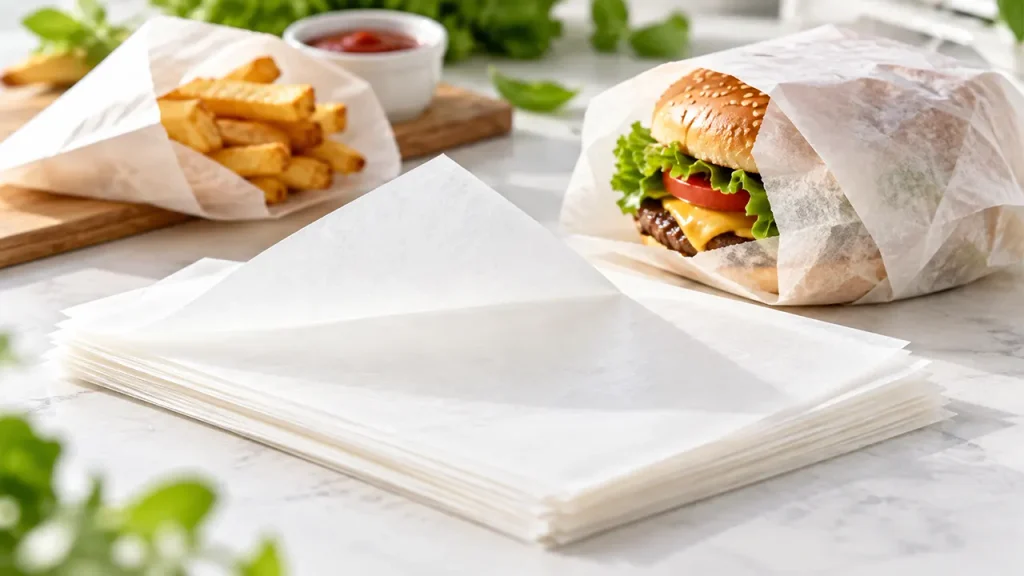
Greaseproof paper is paper designed to resist the passage of oils and fats. In packaging, it is used as a wrap, liner or separator to help keep grease from reaching hands, serving surfaces and outer packaging. Its performance depends on the paper grade and the conditions in which it is used.
That last point matters. A sheet that works well around a cooled pastry may not perform the same way under a hot burger with sauce. Grease resistance also does not automatically mean that the paper is waterproof, non-stick or suitable for an oven.
For restaurants, bakeries and packaging buyers, the useful question is therefore more specific than whether a paper is greaseproof. It is whether the finished sheet can handle a particular, temperature and service time while remaining easy to fold, print and use.
How Does Greaseproof Paper Work?
Ordinary paper has a network of cellulose fibers with spaces between them. A grease barrier makes it more difficult for oil to move through that structure.
One manufacturing route is extensive mechanical refining of the fibers. This helps them bond into a denser sheet, reducing the pathways through which grease can penetrate. In this type of greaseproof paper, the barrier comes from the closely bonded fiber structure rather than a plastic laminate.
Other wrapping papers achieve or modify their barrier performance through surface treatments, coatings or combinations of materials. Those constructions should be identified rather than treated as interchangeable with an uncoated, mechanically refined sheet.
For a buyer, this means that appearance is not enough to identify the material. A smooth finish, brown color or translucent look cannot tell you the full construction. Ask what creates the barrier, whether a coating is present and which side is intended to touch.
Grease Resistance Is a Performance Property
The word greaseproof describes a function, not one universal specification. Two papers sold under that name can behave differently when folded, heated or held against oily.
Rather than asking only for the strongest barrier, define what success looks like. Does the outside need to stay clean until the customer finishes eating? Must a liner remain intact when lifted from a tray? Will the wrap sit inside a box during delivery? These requirements lead to a more useful specification than the product name alone.
What Are the Main Benefits of Greaseproof Paper?
Cleaner Handling and Presentation
A suitable grease barrier can reduce visible oil marks on the outside of a wrap and help keep fingers or serving surfaces cleaner. For served in a basket or open tray, the liner also creates a consistent presentation surface.
The benefit should be assessed at the point of use. A sheet that looks clean immediately after packing but becomes heavily stained before handover may not meet the service requirement.
Protection for Outer Packaging
A liner can help limit grease transfer to a takeaway box, tray or paper bag. This is particularly useful when the outer package provides structure and the inner sheet provides the food-contact barrier.
It does not make a poorly designed package leakproof. Oil can still escape around open folds or exposed edges. Treat the sheet size, folding method and outer container as part of the same packaging decision.
Flexible Formats for Different Packing Stations
Sheets can be sized for a particular wrap or serving tray, while rolls allow staff to cut varying lengths. The better format depends on the operation. A station handling one standard burger may benefit from consistent pre-cut sheets; a deli serving products of different sizes may value flexibility.
Neither format is inherently more efficient. Compare how staff actually pick up, cut, fold and dispense the material during service.
A Surface for Branded Packaging
Printed wraps and liners can carry a logo, pattern or short message close to the. A well-positioned design remains recognizable after the paper is folded or placed inside a basket.
Print coverage should serve the packaging rather than overwhelm it. A simple repeat pattern may be easier to use across different sizes than artwork that only works when a sheet is folded in one exact position.
Common Uses and Applications
Greaseproof grades are used across wrapping, presentation and preparation, but the intended application must match the finished material. Paper selected for wrapping a finished sandwich may have different requirements from paper designed for baking. The, contact conditions and handling method should guide the choice.
Burger and Sandwich Wrapping
A burger wrap needs enough area to cover the and form secure folds without making the package awkward to hold. Test it with the largest menu item, not only the simplest one.
Include sauces, cheese, toppings and the normal packing temperature in the trial. A burger with a wet sauce presents a different challenge from one that mainly releases fat. For delivery orders, inspect the wrap after the expected journey, including the time spent inside the closed outer package.
For sandwiches, consider how the customer opens and eats the. A sheet may be used as a full wrap, a partial sleeve or a surface beneath the sandwich. Each format exposes different areas to and places different demands on the fold.
Bakery and Pastry Packaging
Bakery liners and wraps can be useful for products with butter or other fats at the surface. Selection should also account for sticky fillings, sugar coatings and how the product is displayed.
Separate packaging from baking. A sheet used beneath a finished pastry is not automatically suitable for lining the tray while that pastry is cooked. If both tasks are required, verify each use rather than assuming one paper will cover the whole process.
Basket and Tray Liners
For fries, snacks and other served in baskets, liner size affects both presentation and handling. A sheet that is too small leaves contact areas exposed; one that is oversized may hide the or interfere with eating.
Check the liner with the full serving weight. Observe whether grease reaches the tray, whether damp areas tear and whether printed areas rub against. A liner also does not replace the cleaning procedure required for a reusable serving basket or tray.
Deli Service and Separation
In deli operations, a paper may be used for wrapping, handling or separating portions. Confirm whether the intended task includes brief counter service, refrigerated holding or contact with a moist product.
Grease resistance and easy release are separate requirements. If slices or portions need to separate cleanly, test that behavior directly. Do not assume that a paper that resists oil will release every without sticking.
Baking and Preparation with Suitable Grades
Some greaseproof paper products are specifically designed for baking and cooking. These applications require properties beyond resistance to grease, including suitable heat performance and release behavior. Depending on the and process, the paper may also need to remain strong when exposed to moisture. These properties should be checked separately rather than assumed from grease resistance alone.
For general wrapping paper, do not infer cooking suitability from the name. Use a grade explicitly specified for the appliance, temperature and duration involved.
Greaseproof Paper Compared with Other Papers
paper names overlap in everyday use. A purchase order should describe the construction and required performance instead of relying entirely on a familiar name.
Greaseproof Paper vs Parchment Paper
Greaseproof paper is identified primarily by resistance to oils and fats. Baking parchment is selected for tasks that also require heat suitability and release. Many commercial baking parchments have a release treatment, but the precise construction and limits depend on the product.
For oven use, check the specified temperature limit, exposure time and restrictions for the exact parchment product. A rating given for one baking paper should not be applied to a different sheet or to general wrapping paper.
For wrapping a sandwich, oven performance may be irrelevant. For lining a baking tray, it is central to the decision. Buy for the task.
Greaseproof Paper vs Wax Paper
Wax paper uses a wax coating on a paper sheet. It is a different construction from paper whose grease resistance comes mainly from a dense fiber structure.
The two should not be substituted automatically in a heating application. Follow the exact product instructions, including any limitations on exposure to oven heat. A wrapping material should not become a baking liner simply because both products look similar.
Greaseproof Paper vs Kraft Paper
Kraft paper and greaseproof paper describe different aspects of a material. The word kraft does not establish that a sheet has an oil barrier, and a brown appearance does not prove grease resistance.
When sourcing a brown wrap, ask for its barrier specification as well as its color. A packaging design may call for a natural-looking sheet, but appearance still needs to be matched with the required function.
Greaseproof Paper vs Deli Paper
Deli paper is an application name used for papers intended for deli service, handling or wrapping. It does not describe one fixed material structure.
When comparing a deli paper quote with a greaseproof paper quote, check whether the suppliers are actually offering comparable products. Confirm the base paper, any treatment, sheet dimensions, food-contact use and barrier performance before comparing prices.
What Greaseproof Paper Does Not Automatically Do
It Does Not Automatically Provide a Water Barrier
A wrap may need to cope with fat, sauce, condensation and steam at the same time. Successful performance against oil alone does not establish performance against all of them.
For a hot sandwich with a moist filling, check both grease transfer and the condition of the sheet where moisture collects. If the package becomes soft, investigate the paper, the and the ventilation of the outer container together.
It Does Not Guarantee Crispy or a Longer Shelf Life
A wrap is one part of a packaging system. quality also depends on preparation, holding conditions, ventilation and time before consumption.
Do not treat a grease barrier as proof that fries will remain crisp or a sandwich will stay fresh for a stated number of hours. Those claims need testing with the actual and finished package.
It Does Not Replace a Sealed Container
A folded sheet leaves openings. For products with free liquid, loose sauces or demanding transport conditions, evaluate whether a more suitable container or an additional packaging layer is needed. A higher paper weight will not close an open seam.
How to Choose Greaseproof Paper for Your Business
Start with the and the Service Conditions
Describe the before choosing the paper. Include whether the contact surface is oily, wet, acidic, sticky or a combination of these. Then record the packing temperature, expected contact time and whether the package will be closed, refrigerated or reheated.
These details also matter when checking food-contact suitability. Documentation should cover the intended and conditions, such as contact with fatty foods, moist bakery products, room-temperature storage or heating. A general food-contact statement does not establish suitability for every combination of, temperature and contact time.
Give the supplier a practical description, such as a freshly prepared burger packed for takeaway, rather than requesting paper for an unspecified hot.
Match the Size to the Folding Method
Measure the at its widest and tallest points, then test the overlap needed for the chosen fold. Include room for variation between portions.
An oversized sheet can increase material use and make wrapping cumbersome. A sheet that is too small may expose or open during handling. Try a small range of sizes at the actual packing station before placing a production order.
Understand What GSM Tells You
GSM means grams per square meter. It describes the mass of the paper per unit area; it is not a direct rating of grease resistance, thickness or strength when wet.
Consider two hypothetical sheets with different weights. The heavier one may feel more substantial, but it is not necessarily the better barrier if its structure or treatment differs. Compare the relevant performance data and the finished sample rather than choosing the highest GSM by default.
Ask How Grease Resistance Was Measured
A supplier may quote a KIT rating, which measures resistance to a series of test liquids under defined conditions. This surface-repellency test was developed primarily for fluorochemical-treated papers, so its suitability for other barrier constructions needs evaluation. A KIT number alone does not identify the paper’s chemistry or establish its performance with every.
Ask which method was used and whether it is appropriate for the offered construction. A test result is useful when its scope is understood; it does not replace a trial with hot, folds and the intended holding time. Do not compare isolated numbers from different methods as if they were equivalent.
Evaluate the Finished Printed Sheet
For custom printed greaseproof paper, review the artwork on the final sheet size and in the folded package. Check whether the logo remains visible, small text is readable and the intended food-contact side is clearly identified.
Printing also requires attention to the finished material. Depending on the ink, substrate and conditions, ink components can migrate through the paper or transfer from a printed surface to a food-contact surface while sheets are stacked or wound. The latter mechanism is called set-off. Ink selection, drying or curing, and storage conditions therefore form part of the finished packaging assessment.
For buyers, the practical step is to request information covering the printed article and intended use, not only the unprinted base paper. A claim that an ink is water-based does not, by itself, answer every food-contact question.
How to Run a Useful Sample Trial
A short trial can reveal problems that are difficult to spot in a specification sheet. Keep conditions consistent when comparing samples, and define the acceptance criteria before testing.
- Select representative menu items. Include the most likely to challenge the wrap, such as the oiliest filling or the wettest sauce normally served.
- Pack the as staff normally would. Use the real portion size, folding method and outer container.
- Inspect at meaningful times. Check immediately after packing, at normal handover and after the expected delivery or holding period.
- Record separate observations. Note oil staining, moisture damage, tearing, sticking, loose folds and print appearance rather than reducing everything to a single pass or fail.
- Compare the customer experience. Open and handle the as a customer would, including any peel-back or partial-unwrapping step.
Photograph the same areas under similar lighting and retain the sample identification. If one paper fails, record where and under what conditions. This makes it easier to determine whether the solution is a different paper, a larger sheet, a changed fold or a different outer package.
An operational trial checks suitability in service. It does not replace the documentation or laboratory work needed to substantiate food-contact, environmental or other regulated claims.
Is Greaseproof Paper Environmentally Friendly?
There is no single environmental answer for every greaseproof paper. Assess the material construction, how much is used and what happens to the finished sheet after use.
Start by separating three questions: where the fiber comes from, what treatments or coatings are present, and which waste route is available. A claim about responsible fiber sourcing does not establish recyclability, and a paper-based appearance does not prove the absence of plastic or other treatments.
Can It Be Recycled?
Check the finished material and the local collection rules. Technical recyclability and acceptance in a particular collection stream are different questions. contamination also matters: used sheets containing grease or residue may be excluded from local paper collections even when the unused material has a documented recycling route.
If customers will use the product in several countries, verify the intended disposal instructions for each market instead of printing an unrestricted recycling claim. Keep instructions specific to the finished wrap and the collection system available to the customer.
Is It Compostable or Biodegradable?
Ask for evidence covering the finished product, including coatings and printing where relevant. Confirm whether the claim concerns industrial composting, home composting or another defined set of conditions, and whether the destination facility accepts the item.
Do not use biodegradable as a substitute for disposal instructions. It does not tell the customer where to place the used wrap or how quickly it will break down in the environment where it ends up.
What About PFAS Claims?
If a purchasing policy requires information about PFAS, request a clear supplier statement and supporting evidence appropriate to that policy. Specify whether the requirement concerns intentionally added substances, a particular analytical test or a defined threshold. A product name or general description cannot settle that question.
Frequently Asked Questions
Is Greaseproof Paper the Same as Baking Paper?
Not necessarily. Some products are specified for both grease resistance and baking, but general wrapping paper should not be assumed suitable for oven use. Check the exact product’s heat limits and instructions.
Does Greaseproof Paper Absorb Oil?
Its main purpose is to resist oil passing through, rather than to act as an absorbent towel. If the operation requires removing excess surface oil, specify that as a separate task and choose a material intended for it.
Which Side Should Touch the?
Follow the supplier’s instructions for the exact construction. Coatings or printing may make the two sides different. Do not rely solely on which side looks shinier, particularly with custom printed material.
Can Greaseproof Paper Be Used in a Microwave or Air Fryer?
Only use a product explicitly suitable for the appliance and conditions. Grease resistance alone does not establish heating suitability. Follow both the material instructions and the appliance manufacturer’s directions rather than adapting a wrapping sheet on assumption.
Is Brown Greaseproof Paper Better Than White?
Color alone cannot establish better grease resistance, food-contact suitability or environmental performance. Compare the actual construction and evidence, then choose the appearance that fits the packaging design.
What Should a Custom Paper Quote Request Include?
Include the type, packing conditions, required sheet size, estimated quantity, artwork, destination market and any required documentation. Ask the supplier to identify the proposed paper construction and sample specification so that the quote can be evaluated against the intended use.
Choosing a Paper That Fits the Job
Greaseproof paper is most useful when its barrier, format and handling properties match the being served. The right specification starts with the menu and packing process, then checks the finished sheet under realistic conditions.
Before ordering, bring together the description, contact conditions, sheet size and printing requirements. Use those details to request comparable samples and quotations. That gives a restaurant or packaging buyer a clearer basis for selection than appearance, GSM or the word greaseproof alone.