Most packaging specifications are inherited, not designed. A material gets copied from the previous SKU, a supplier suggests what’s in stock, and the brief moves to artwork before anyone has asked what the product actually needs. The result is usually one of three failures: an over-engineered barrier that costs 20% too much, a grease-resistant pack that fails in the delivery bag, or a recyclable claim the material can’t support.
Choosing well comes down to a short sequence of decisions — provided you ask them in the right order.
Start With the Product, Not the Material
Before comparing board grades or film structures, write a one-page product profile. Every material decision follows from it.
- Product chemistry: moisture content, fat, pH, salt, alcohol, volatile aroma.
- Sensitivity: oxygen, light, and aroma pickup.
- Shelf life: 3 days, 3 weeks, or 12 months — three completely different engineering problems.
- Process: hot fill, retort, aseptic, blast freeze, microwave, oven.
- Handling: delivery, e-commerce, vending, takeaway, meal kits.
- Market: where it’s sold, how it’s disposed of, what labeling is required.
Most wrong specs trace back to one missing line in this profile. A sauce with 12% fat and pH 3.2 needs a different structure from a sauce with 25% fat and pH 6.5 — even if both are “a sauce.”
Match the Material to the Application
| Application | Workable materials | Watch-outs |
|---|---|---|
| Hot drinks | Coated paperboard, double-wall board, PP | Coating choice decides recyclability |
| Cold drinks | PET, PP, coated board, glass | Condensation weakens uncoated board |
| Hot takeaway | Molded fiber, PP, coated board | Grease penetration at seams and corners |
| Chilled ready meals | PP trays, coated board, CPET | Seal integrity through the chill chain |
| Frozen | PE-coated board, PP, laminated film | Moisture and ice-crystal abrasion |
| Bakery and dry goods | Uncoated board, greaseproof paper, film | Grease migration through paper |
| Snacks and confectionery | Metallized film, mono-PE, laminates | Recyclability vs barrier trade-off |
| Sauces and condiments | Glass, PET, laminated pouches | Acid and oil resistance |
| E-commerce meal kits | Corrugated, insulated liners, molded fiber | Drop strength and condensation |
No material wins everywhere. The table narrows the shortlist; the next four checks decide it.
In practice, shortlist two or three candidates, not eight. Every additional material adds a tooling set, a compliance file, and a second supply chain — and most products only need one of them to work.
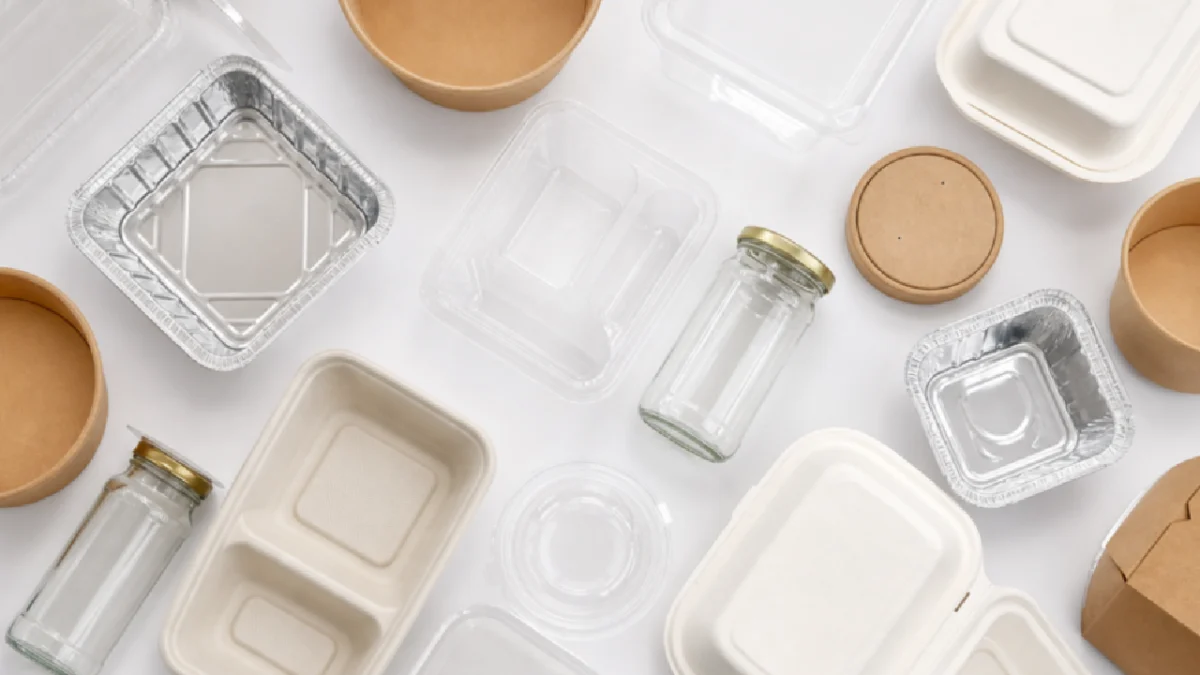
What Each Family Delivers
- Paper and board — cheap, printable, widely recycled, and easy to customize; barrier is weak without a coating, and the coating decides repulpability.
- Plastics — the best barrier-to-weight ratio; PET and PP recycle well, PS and multi-material laminates barely recycle at all.
- Glass — inert, impermeable, and infinitely recyclable; heavy to ship and energy-intensive to melt.
- Metal — absolute barrier with retort capability and the highest scrap value; internal coatings are the weak point.
The families differ less in what they can do than in what they cost to do it — which is why the application table is a better starting point than a favorite material. A drinks range, for example, will shortlist paper cups and PP almost automatically; the real decision then turns on coating.
Check Process Compatibility
Material choice is often made for you by the filling line.
- Hot fill above 85°C rules out most PLA and thin coated boards.
- Retort means metal, glass, or retort pouches — paper is out.
- Microwave rules out metallized films and foil laminates.
- Blast freezing demands moisture resistance and low-temperature flexibility.
- Heat sealing requires compatible coating on both lidding and base; seal strength must survive the distribution chain.
A material that passes the product test but fails the line is not a candidate.
Specify the Barrier the Product Needs
Barrier performance is where over-specification quietly costs the most.
- Moisture (WVTR) — dry and crispy products.
- Oxygen (OTR) — fats, nuts, coffee, cured meats.
- Grease resistance — hot, bakery, fried snacks.
- Light — dairy, oils, some beverages.
A coated board with a moderate moisture barrier is usually enough for a three-week bakery product; a metallized laminate is not. Ask for measured values and test conditions, not adjectives like “high barrier.”
The cheapest way to get this wrong is to copy the barrier from a longer-shelf-life product in the same category. Barrier is a function of shelf life, storage temperature, and the product’s sensitivity — not of the aisle it sits in.
End-of-Life and Market Rules
Recyclability depends less on the material than on where the pack is sold and collected. A mono-material pack with a clear disposal instruction will outperform a technically recyclable laminate in most markets.
Three rules now shape specifications: the EU’s PPWR requires all packaging to be recyclable by 2030; EPR fees in the UK and EU price poor recyclability directly; and PFAS restrictions are eliminating traditional greaseproof treatments. Compostable formats only make sense where industrial composting actually exists.
Design for the stream that exists — not the one on the marketing deck.
Cost Drivers
Unit price is the least useful number in packaging. Build a landed cost per unit:
- Material grade and coating — the single largest lever;
- Print — number of colors, coverage, and process (flexo, offset, digital);
- Tooling — die-cut formes, molds, print plates;
- Order quantity — small runs carry a disproportionate setup cost;
- Freight and cube — lightweight paper saves on transport, glass does not;
- EPR fees and disposal costs in each market.
A cheaper substrate that needs a heavier gauge, a second layer, or a premium coating usually costs more by the time the pallet ships. If paper formats are on the shortlist, start from our packaging materials range and work back to cost.
Sample, Then Validate
Never approve a material from a datasheet alone. A proper validation set includes:
- Material datasheet and declaration of compliance;
- Migration test report for food-contact;
- Seal strength and leak test;
- Drop, compression, and vibration tests;
- Shelf-life trial under real storage conditions;
- A pilot run on the actual filling line.
Typical timelines: 2–3 weeks for samples, 4–6 weeks for new tooling once artwork is approved. Plan the launch backwards from the tooling date, not the print date.
A Simple Scorecard
Weight the criteria before scoring, so the decision isn’t driven by the loudest opinion:
| Criterion | Weight |
|---|---|
| Barrier fit for the product | 25% |
| Process compatibility | 20% |
| Compliance and documentation | 20% |
| End-of-life in target markets | 15% |
| Landed cost | 10% |
| Supply reliability and lead time | 10% |
Score each shortlisted material 1–5, multiply, and compare. Anything scoring below 3 on compliance should be eliminated regardless of total.
Common Specification Mistakes
- Choosing the material before defining the barrier requirement.
- Copying a spec from a different market with different disposal routes.
- Assuming ” grade” equals documented compliance.
- Ignoring the coating when specifying paper.
- Underestimating tooling and setup costs at the sampling stage.
- Treating EPR fees as a rounding error.
FAQ
How do I choose packaging materials for a new product?
Define the product profile first — chemistry, shelf life, process, distribution, market — then shortlist materials by application and validate with samples and migration testing.
Which material is best for hot takeaway?
Molded fiber and PP perform best. Coated board works for shorter holding times, provided the seams and corners resist grease.
Is paper always more sustainable than plastic?
No. Paper wins on weight and recycling in many markets, but coatings can make it unrecyclable, and barrier performance may require more material overall.
What is the difference between recyclable and compostable packaging?
Recyclable means the material can be processed into new material; compostable means it breaks down in industrial composting. Most compostable packs contaminate paper recycling.
How long does it take to develop a new packaging specification?
Usually 6–10 weeks from brief to production-ready: 2–3 weeks for samples, 4–6 weeks for tooling once artwork is approved.
When should I use molded fiber?
When you need a rigid, heat-tolerant pack for a short-life product — takeaway trays, produce baskets, egg cartons — and the market has paper recycling or industrial composting.
Can one material cover an entire product range?
Rarely. Most ranges settle on two or three materials chosen for shelf life and process, then standardize sizes and print to keep costs down.
The Bottom Line
packaging materials are an engineering decision before they are a marketing one. Start with the product profile, let the process narrow the shortlist, specify only the barrier you need, and validate before you commit to tooling. When the shortlist is settled, move on to packaging design — turning a material into a structure and a shelf-ready pack.
The packs that perform best are rarely the most advanced on paper. They’re the ones where every choice traces back to a requirement someone actually wrote down.