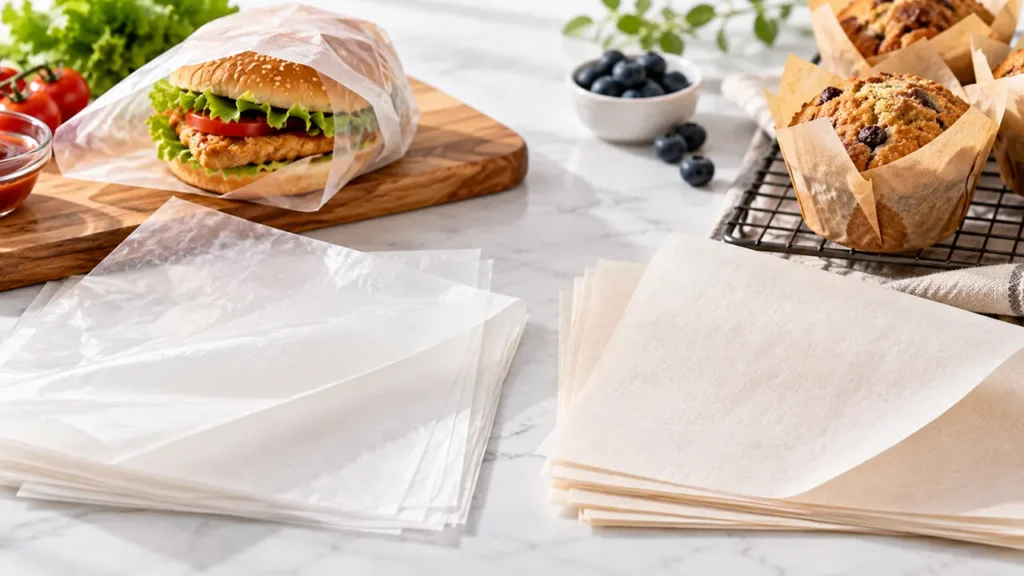
Greaseproof paper and parchment paper look similar, feel similar, and are routinely used in place of one another in commercial kitchens and packaging lines. They are made differently, behave differently under heat, and cost differently — and the gaps matter most in exactly the situations where people substitute them.
This comparison separates the two by construction, performance, and application, so the choice is based on what the paper has to do.
The Short Answer
Greaseproof paper is dense paper with no coating: its grease resistance comes from how the fibres are refined. Parchment paper is either acid-treated (vegetable parchment) or silicone-coated (baking parchment), which makes it heat-stable and nonstick.
Greaseproof wins on strength, wet performance, and cost. Parchment wins on heat resistance, nonstick release, and oven safety.
How Each Paper Is Made
The manufacturing route explains almost every behavioural difference that follows.
Greaseproof: density, not chemistry
Greaseproof paper is made by refining wood pulp for a long time until the fibres hydrate and collapse. The resulting sheet is dense and low-porosity, so fat cannot wick through it quickly. No coating is applied — the barrier is mechanical.
That is why greaseproof feels heavy and slightly glassy for its weight, and why it holds up when wet. It is also why it is hard to repulp: the same density that blocks grease slows water penetration in a pulper.
Parchment: acid or silicone
“Parchment” covers two products.
Vegetable parchment is paper passed through a sulphuric acid bath, which gelatinises the surface fibres. The result is grease-resistant, heat-stable, and slightly translucent — the classic baking parchment.
Silicone-coated parchment is paper with a thin silicone layer cured onto the surface. It is the product most people mean by “baking paper” today: nonstick, oven-safe, and available in rolls and sheets.
Both are heat-tolerant. Neither is a moisture barrier in the way greaseproof is.
At a Glance
| Property | Greaseproof | Parchment |
|---|---|---|
| Barrier mechanism | Dense fibre, no coating | Acid treatment or silicone |
| Grease resistance | High | High |
| Heat resistance | Not rated for oven use | Typically 425°F / 220°C |
| Nonstick | Low | High |
| Wet strength | High | Moderate |
| Printability | Good | Poor — silicone resists ink |
| Cost | Lower | Higher |
| Typical use | Wrapping, interleaving, liners | Baking, roasting, lining |
Heat and Nonstick Performance
This is where substitution goes wrong most often.
Greaseproof paper is not designed as a baking liner. It has no release coating, so cakes and breads stick to it, and it is not rated for oven temperatures — it can scorch, become brittle, and transfer odour at high heat. Some food-service operators use it at moderate temperatures for short bakes, but that is a working practice, not a manufacturer’s rating.
Parchment is built for the oven. Silicone parchment is typically rated to 425°F (220°C), with some products claiming 450°F (232°C), and it releases cleanly. It still fails under a broiler or against a heating element: oven-safe is not fire-safe.
If the job is baking, parchment is the correct answer. If the job is wrapping, greaseproof is cheaper and stronger.
Where Each One Belongs
The application usually decides the material before the specification does.
Greaseproof: burger and sandwich wraps, basket and tray liners, pastry bags, sandwich interleaving, cheese and deli wrapping, separating frozen portions.
Parchment: baking sheets, cake tins and loaf pans, roasting vegetables, en papillote, dehydrating, proving dough.
The overlap is small — cold wrapping versus oven work — which is why most professional kitchens stock both.
Grease and Moisture
Both resist fat, but for different reasons and to different degrees.
Greaseproof’s density slows fat migration and gives it an advantage in wrapping hot, greasy — burgers, fried chicken, pastries. It also holds moisture in better than parchment, which matters for bread, cheese, and anything that should not dry out.
Parchment resists grease through its surface treatment, but it is a weaker moisture barrier and can become translucent and limp when wrapped around wet. For a wrapped sandwich sitting in a delivery bag for 20 minutes, greaseproof is usually the safer sheet.
Print and Converting
For branded packaging, printability decides the specification.
Greaseproof takes ink well and is commonly printed with one or two colours for service. It converts cleanly: folding, crimping, and bag-making are all routine.
Parchment is difficult to print because silicone and acid-treated surfaces repel ink. Most parchment is sold unprinted, and where printing is required it usually needs a different surface or a label. For custom-printed wraps, greaseproof is the practical substrate.
Safety and Compliance
Both are food-contact materials, and both need documentation.
- Greaseproof is uncoated, so the compliance question is the fibre and any additives used in refining. Recycled fibre is restricted for direct contact in most markets.
- Vegetable parchment carries trace acid residues from manufacturing, but food-grade production includes neutralising and washing steps.
- Silicone parchment is inert and heat-stable; look for food-grade certification.
- PFAS is the issue to watch. Some heavy-duty “greaseproof” papers were treated with PFAS to boost performance, and those treatments are being banned across the US and EU. Ask for a PFAS-free declaration.
Hot, fatty is the worst case for any paper, so ask for migration test data at the intended use temperature rather than a generic food-contact certificate.
Recyclability and Compostability
Neither is straightforward, and neither should be described simply as “recyclable.”
- Uncoated greaseproof is fibre and can be repulped in principle, but soiling and small format keep it out of most collection systems.
- Vegetable parchment is also fibre-based and generally compostable in commercial facilities.
- Silicone parchment is usually compostable industrially but rarely recyclable, because the silicone layer contaminates the paper stream.
If recyclability is part of the brief, read our guide to whether greaseproof paper is recyclable before the specification is fixed — the coating, not the base sheet, usually decides the answer.
Packaging claims should match the market’s actual collection route — not the material’s theoretical potential.
For converters, greaseproof is the easier substrate: it runs on standard flexo presses and bag-making lines without modification, while parchment usually requires a different surface or an unprinted format.
Cost per Sheet vs Cost per Use
Greaseproof is usually cheaper per sheet, and often cheaper per tonne. But price per sheet misleads in both directions.
Parchment’s release property can replace greasing, reduce sticking failures, and be reused for several dry bakes. Greaseproof’s strength allows a lower grammage for the same load, so the cheaper sheet can also be the lighter one. Compare cost per wrapped item and cost per bake — not the price on the roll.
When to Substitute
Parchment for greaseproof: usually acceptable for cold wrapping and interleaving, though it is stiffer and more expensive.
Greaseproof for parchment: only for lining at low temperatures, and expect sticking. It is not a nonstick surface.
The safe rule: substitute parchment for greaseproof when in doubt, never the reverse in a hot oven.
Buying Checklist
- Ask for the heat rating on parchment and the coating status on greaseproof.
- Confirm PFAS-free if the paper claims heavy grease resistance.
- Check grammage and wet strength if the wrap will hold hot, oily.
- Request a print proof on the actual stock before approving artwork.
- Confirm the disposal route in the market where the pack is sold.
FAQ
Is greaseproof paper the same as parchment paper?
No. Greaseproof is dense, uncoated paper; parchment is acid-treated or silicone-coated and heat-rated.
Can I use greaseproof paper instead of parchment?
For low-temperature lining, sometimes. It sticks, has no oven rating, and is not a substitute for baking parchment.
Can I use parchment instead of greaseproof?
Yes for cold wrapping, though it is stiffer, more expensive, and a weaker moisture barrier.
Is greaseproof paper oven-safe?
It is not rated for oven use. Parchment is the oven-safe option.
Which is better for wrapping burgers?
Greaseproof, because of its wet strength and moisture resistance.
Are either of them recyclable?
Uncoated greaseproof and vegetable parchment are fibre-based; silicone parchment usually is not recyclable, though it may be compostable.
Is vegetable parchment the same as baking parchment?
Not exactly. Vegetable parchment is acid-treated; most modern baking parchment is silicone-coated. Both work in the oven, but they are different materials with different disposal routes.
The Bottom Line
Greaseproof and parchment solve different problems with the same silhouette. One is dense fibre doing a mechanical job; the other is chemistry doing a thermal one.
Choose by the job: greaseproof for wrapping, interleaving, and moisture protection; parchment for baking, release, and heat. And when a supplier quotes one as a substitute for the other, ask which property is being traded — because something always is.