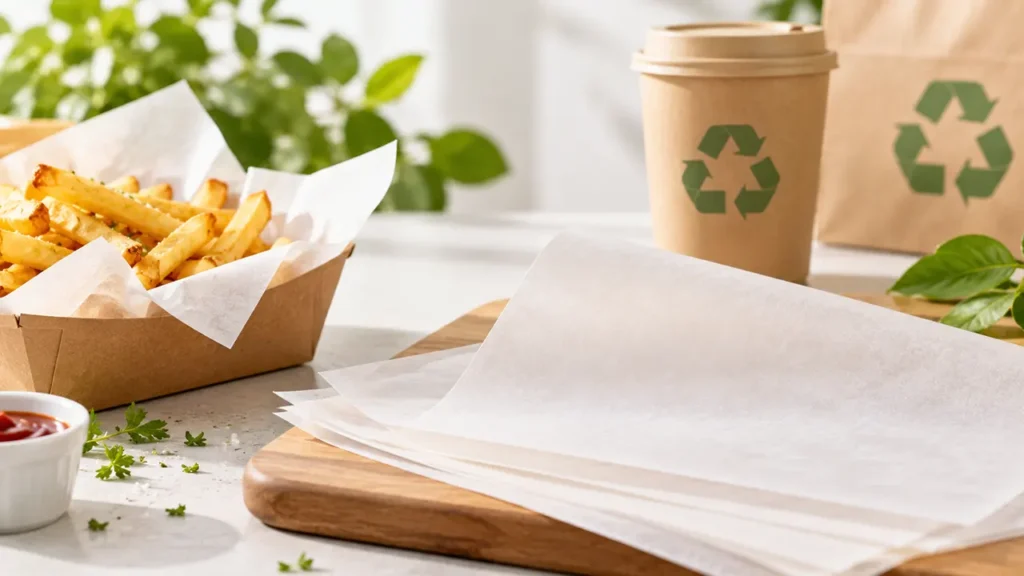
Greaseproof paper is one of the most common materials in service: burger wraps, bakery bags, sandwich interleaves, tray liners, and basket liners. It is also one of the most frequently mislabelled when it comes to disposal. Suppliers call it recyclable, compostable, or both, and the pack rarely says which version you are holding.
The honest answer is that greaseproof paper is recyclable in principle and unreliable in practice. Whether your specific paper makes it through a mill depends on three things: how it was made, what it is coated with, and how dirty it is when it reaches the bin. Most of the sheets sold as wrapping paper for burgers, bakery, and takeaway sit in the same family — and the same three questions apply.
The Short Answer
Uncoated greaseproof paper is made of cellulose fibre and can be repulped. Coated, waxed, laminated, or PFAS-treated versions usually cannot be recycled in standard mills, and food-soiled paper is rejected by most collection systems regardless of the base material.
So: recyclable sometimes, compostable sometimes, and “neither” more often than the marketing suggests.
What Greaseproof Paper Actually Is
The name covers several products that behave differently.
How it is made — and why that matters
True greaseproof paper is made by refining pulp for a long time until the fibres hydrate and collapse. The result is a dense, low-porosity sheet that resists fat without any coating at all. That density is the reason it works — and the reason it is hard to repulp: the same structure that blocks grease also slows water penetration in a pulper.
Vegetable parchment is a cousin, made by passing paper through a sulphuric acid bath, which gelatinises the surface. It is grease-resistant, heat-stable, and often used for baking.
The three versions on the market
- Uncoated greaseproof — fibre only, no barrier layer. The most recyclable and compostable version.
- Waxed greaseproof — coated with paraffin or soy wax for moisture resistance. The wax contaminates repulping and is not designed for heat.
- Silicone-coated or PFAS-treated — silicone for nonstick baking, PFAS for heavy grease resistance. Silicone is largely incompatible with paper recycling; PFAS is under regulatory pressure and increasingly restricted.
If you do not know which one you have, you cannot answer the recyclability question — and neither can your customer.
Why the Coating Decides Everything
Recycling a paper sheet means turning it back into pulp. Anything that does not break down with water and agitation becomes contamination. That single principle explains recyclability across packaging materials, not just this sheet.
Uncoated greaseproof
Uncoated sheets are compatible with repulping in principle. In practice, most mills will not take them as a separate stream because the volumes are small and the fibre is short. Mixed with other paper, they can be accepted — but residue remains the limiting factor.
Waxed and laminated
Wax melts in the pulper and forms sticky deposits that clog screens. Laminated structures — greaseproof bonded to film or foil — are effectively unrecyclable and are usually incinerated or landfilled.
PFAS-treated
PFAS chemistry is what gave paper its best grease resistance for decades, and it is also what makes the sheet non-recyclable in many mills and non-compostable. Several US states have banned PFAS in packaging, and the EU is restricting it under REACH. Even where it is still legal, a PFAS-treated sheet is a disposal liability.
The Contamination Problem
Even perfectly recyclable paper fails if it is covered in.
Why residue matters
Grease, sauce, and crumbs contaminate the pulp and lower the yield of the whole bale. Mills set contamination thresholds, and a load with visible waste is rejected — often at the cost of the collector, which is why many programs stop accepting wrappers altogether.
Why size and volume matter
Small sheets fall through sorting equipment and are treated as residue. A single burger wrap has little material value and high handling cost, so the economics rarely justify a dedicated stream outside closed-loop settings such as stadiums, campuses, or large quick-service chains.
What Happens in the Mill
Where greaseproof paper is accepted, the process is standard repulping:
- The paper is baled with other recovered paper.
- It enters a hydrapulper with water and agitation.
- Fibre disperses; coatings and contaminants are screened out.
- The pulp is cleaned, de-inked if needed, and re-formed into new paper.
Uncoated sheets behave like any other paper. Coated sheets add rejects, downtime, and cost — which is why mills price them out of the stream.
Recyclable or Compostable? Not the Same Thing
A greaseproof sheet can be one, both, or neither.
- Uncoated greaseproof is generally compostable in commercial composting and recyclable in principle.
- Waxed is usually not compostable at home and not recyclable.
- Silicone-coated is often marketed as compostable but rarely recyclable.
- PFAS-treated is neither, and is being regulated out of the market.
The claim on the pack is not the answer. The material declaration is.
One more distinction matters: home composting and industrial composting are different tests. A sheet that breaks down in a commercial windrow at 55–60°C may sit intact in a garden bin for a year. “Compostable” without a route to industrial composting is a claim, not an outcome.
What the Rules Say
Regulation is moving toward making this simpler — and more expensive for poor choices.
The EU’s Packaging and Packaging Waste Regulation requires all packaging to be recyclable by 2030, and EPR fees in the UK and EU price hard-to-recycle formats directly. PFAS restrictions are removing the easiest route to heavy grease resistance. In the US, state-level EPR laws and PFAS bans are doing the same job from the other direction.
The practical effect: a greaseproof paper that cannot be recycled now carries a cost, not just a marketing risk.
How to Tell What You Have
Three checks before you trust a supplier’s claim:
- Look and feel. A waxy sheen and a soft hand suggest wax. A slick, slightly plastic feel suggests silicone. A dry, dense sheet with no sheen is likely uncoated.
- The water test. A drop of water beads on waxed and silicone surfaces; it darkens and spreads on uncoated paper.
- Ask for the declaration. The coating, the food-contact compliance, and the repulpability claim should all be documented. A supplier who cannot name the coating cannot guarantee the disposal route.
- Ask where it is sold. A sheet that recycles well in one market may have no collection route in another. The claim should match the market, not the catalogue.
What to Specify Instead
If recyclability matters for the SKU, the specification has to change, not just the label.
- Choose uncoated where the product allows. Dry bakery, sandwich interleaves, and short-contact wraps often do not need a barrier.
- Avoid PFAS. Require a PFAS-free declaration and test the grease resistance of the alternative before launch.
- Keep it mono-material. No film windows, no foil laminates, no wax on a fibre pack that is meant to be recycled.
- Design for the collection route. If the market has no food-waste or paper collection for the format, the recyclable claim is theoretical.
- Label clearly. “Not recyclable — food-soiled” is more honest, and more useful, than a green icon.
FAQ
Is greaseproof paper recyclable?
Uncoated greaseproof paper is recyclable in principle, but coated, waxed, and PFAS-treated versions usually are not, and food-soiled paper is rejected by most programs.
Can greaseproof paper go in the recycling bin?
Usually not at kerbside. Check local rules; small, food-soiled sheets are commonly excluded.
Is greaseproof paper compostable?
Uncoated versions can be composted commercially. Waxed and PFAS-treated versions should not be.
Is baking paper the same as greaseproof paper?
No. Baking paper is usually silicone-coated parchment, designed for oven use. Greaseproof is denser and not necessarily heat-rated. The two are compared in detail in our greaseproofpapervs parchment paper guide.
Is greaseproof paper the same as wax paper?
Not always. Waxpaperis coated with wax; greaseproof may be uncoated, waxed, or silicone-treated, and the two materials fail in the oven for different reasons.
What is the most recyclable greaseproof option?
Uncoated, PFAS-free, mono-material paper collected through a route that actually accepts food-soiled paper.
Does greaseproof paper break down in landfill?
Slowly, and not usefully. Landfill is anaerobic and dry; even uncoated paper degrades over years, and coated versions persist far longer.
The Bottom Line
Greaseproof paper is recyclable when it is just paper — and most of what is sold as greaseproof is not just paper. The coating that makes it work is the same thing that keeps it out of the recycling stream.
For buyers, the question is not “is greaseproof paper recyclable?” but “which greaseproof paper, sold into which market, disposed of through which route?” Answer those three and the material choice follows.